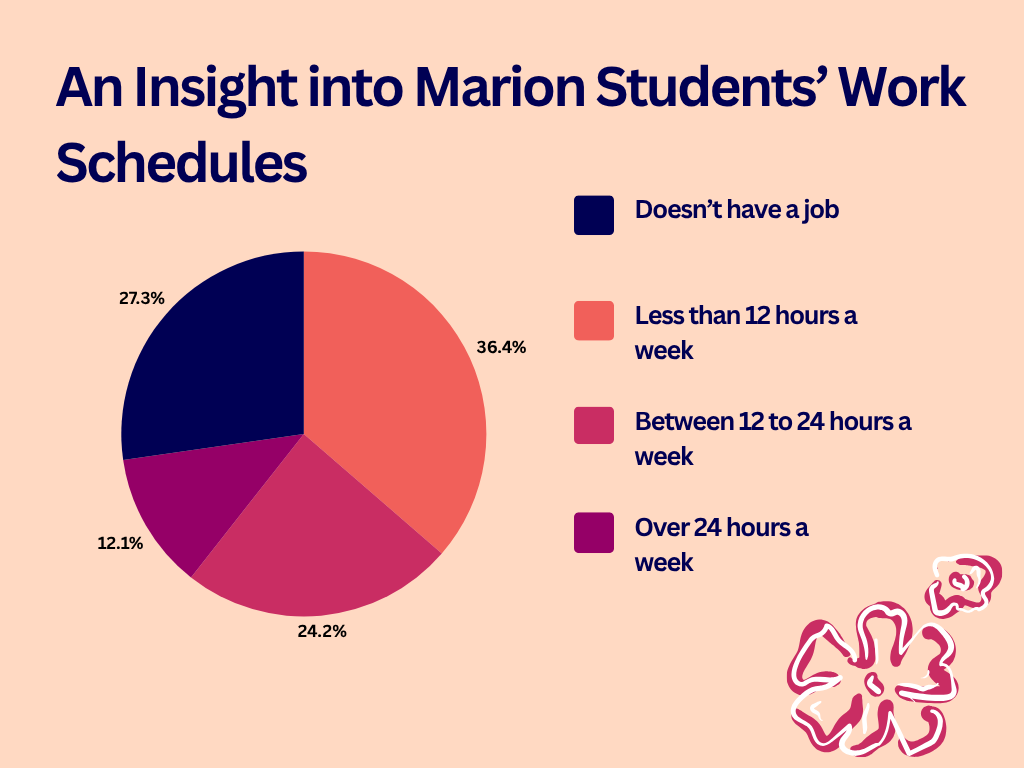
For many high schoolers, life consists of a constant loop with no time to breathe. Countless teenagers and young adults are involved in a considerable amount of after-school commitments: work, sports, clubs, volunteering, home responsibilities, and more. These add up quickly, and suddenly, one finds oneself in a routine with insufficient sleep and constant overwhelm. No matter how hard one works, there always seems to be more to do, more assignments to complete. While being driven and productive are great qualities, today’s students face the risk of becoming overworked, raising the question of how much is too much for healthy development.
According to the CDC, teenagers should get around eight to ten hours of sleep a night, but the majority do not meet this goal. Tara Devaney, junior, has worked at Buffalo Wild Wings for over a year and typically works 30 to 40 hours per week during the school year. She mostly welcomes this schedule, though, because of the substantial paychecks. However, she experiences sleep loss due to late nights at work. She said, “There were plenty of times I had to call out of first block because if I go to sleep too late, I don’t wake up, no matter how many alarms I set.” Devaney feels her job isn’t overtly stressful, except for occasional unsafe conditions that management fails to resolve.
America’s capitalist structure promotes hyperproductivity and monetary gain to benefit the economy; more input brings more money. Erik Trilk, English teacher, had two jobs in high school: working at Little Caesars and as a hockey referee. He wishes that teenagers didn’t feel the need to work on top of school and sports, but it’s nearly inevitable today. He said, “In our country, you have to have money. You kind of have to have a job even though there are European countries where they don’t want teenagers to work for that very reason.” Trilk feels that adolescents need more time to be young and enjoy social time with friends and family.
There are several reasons a high schooler may want a job, but all stem from one simple concept: money. Whether it’s to buy a coffee, enjoy new clothes, or save for college, having some extra padding in one’s wallet is immensely appealing to teens. Trilk said, “No matter how much you like your job, it’s for the money because you want to be able to spend it on stuff that you want, like records or the things you have to have.” Despite these positive aspects of obtaining a job, the side effects of overworking may not be worth it.
While it is commonly agreed upon that sleep is crucial to maintaining health, some may not realize how much it truly impacts them. The National Institutes of Health found that adolescents are at a higher risk of mood disorders, which can both cause and be a consequence of sleep deprivation. Additionally, studies show that overworking oneself through employment and school can cause a weakened immune system and a higher risk of cardiovascular issues. Even though today’s society praises long workweeks, one needs to find balance and prevent these long-term health implications.
Sometimes, pinpointing whether one is experiencing job burnout can be difficult. For example, even though Devaney works long shifts and feels as though the business could be run better, she is overall satisfied with her work life. She said, “I think everyone else would say they feel overworked there, but I feel like since it’s the only job I’ve had, I don’t have anything to compare it to, so I don’t feel overworked.” A useful method to determine whether one is overburdened is if they feel worn out and lack energy, signaling a necessary break.
Overall, it is imperative to make rest a priority, even when time feels finite. Remember to take time to breathe and take a step back from the load of responsibilities. Make time for loved ones and keep in mind that occasional breaks improve productivity, benefiting one’s work life in the long run.