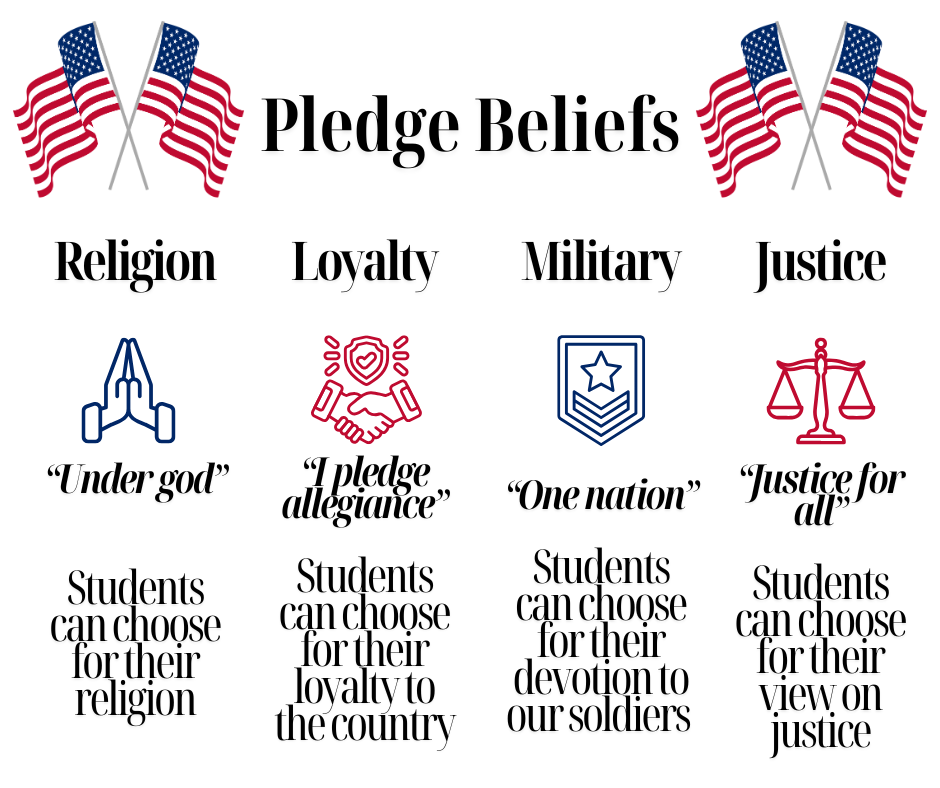
“I pledge allegiance to the flag of the United States of America, and to the Republic for which it stands, one nation under God, indivisible, with liberty and justice for all.”
The oath everyone takes during school, the same one that’s been switched three times, from “my flag,” to “the flag of the United States of America,” to the final version today, including “under God.” This simple recitation each day is a promise of loyalty, justice, and unity as one nation.
The pledge has been a habit instilled in kids since elementary school, with students being taught to stand and recite it, with their right hand over their heart. But what if one didn’t stand because “liberty and justice for all” isn’t occurring? At the high school, during daily announcements, starting with the pledge, students are asked to stand or sit quietly, allowing them to uphold their beliefs respectfully.
To take an oath five days a week, repeating the words one is expected to believe and defend. Some feel as if the message isn’t being implemented, and that the country has been divided. Lily Cowdin, junior, said, “I really disagree with a lot of the stuff that’s happening in this country. So for me, it doesn’t feel right to stand for the pledge, and to state that there’s ‘liberty and justice for all,’ when we’re far from that.” She is one of the many students at the high school who share her view. Chayse Restivo, freshman, shares the same perspective. He said, “I don’t really think what’s going on in the country right now is a good thing…I don’t think I should be pledging allegiance to a country that doesn’t respect its citizens.” While Cowdin and Restivo oppose current events, they both believe in change for the better and respect for others, which would make them consider standing again.
For those who do stand for the pledge, their beliefs range from religious ideals to family members who are currently serving or who have served, and beyond. Micah Bushlack, junior, said, “I love my country. I think that if I’m pledging my loyalty to the country, I feel like I should stand.” Teens at the high school are encouraged to support their beliefs, and this is an impactful way to do so.
While others’ opinions may vary, it is important to respect them. Most of Bushlack’s friends also stand for the pledge, but if someone made the choice not to, he would be curious to understand and learn why. On the other hand, Cowdin and Restivo have both had students ask them why they sit, but no one mocks them or shows them rudeness. This is key to being able to have these choices, as simple as standing or sitting.
A student’s actions should reflect their ideas at every opportunity. Events as manageable as these have a greater impact than one might think, allowing individuality and opinions to be highlighted in ways that give security and representation.