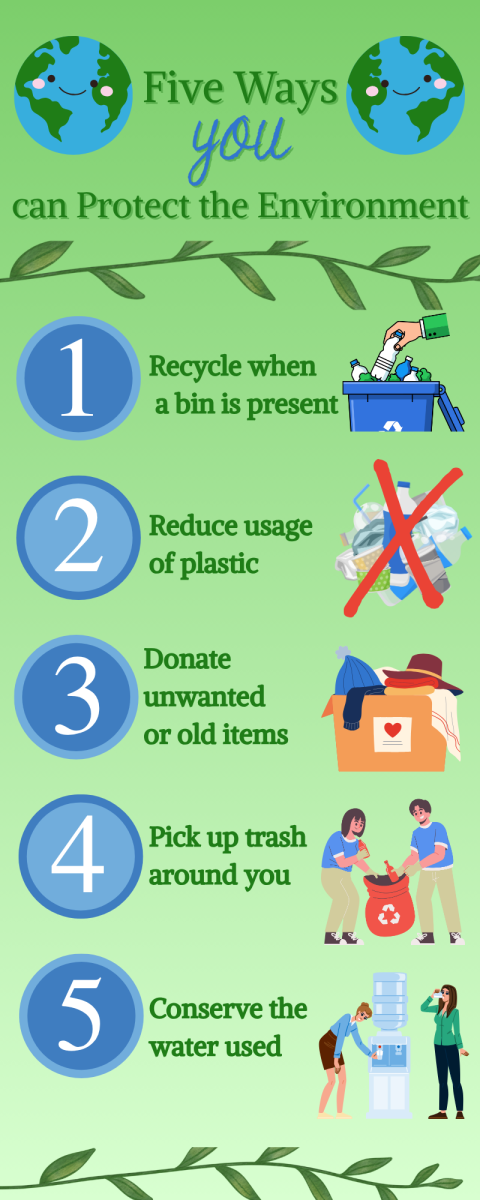
From the hallways to the parking lot, trash can be seen in nearly every corner of the high school, but have the students actually stopped to notice how much there actually is? Although recycling bins are placed throughout the school, many students may not realize the impact that improperly disposing of items can have on the environment. The saying, “Reduce, Reuse, Recycle,” has been heard by many people, and it aims to teach them about the method of reprocessing and its benefits. Additionally, two students who currently attend the high school shared their similar perspectives on the issue.
Brooks Morris, sophomore, says it’s often the case that students can be seen throwing plastic away in the wrong bin. He frequently catches sight of litter around the school; Morris said, “There’s trash everywhere, to be honest, it just depends where it is, but yeah, it’s just everywhere.” In addition, classrooms that allow students to bring food or drinks may have more trash than others, especially if teachers don’t monitor it closely enough.
He also explains that he’s seen students failing to sort waste properly, which contributes to the problem. “I’ve seen a lot of plastics and stuff in garbage cans, and quite the opposite as well,” Morris said. Throughout the campus, students can see numerous trash and recycling bins, but this issue is not limited to the high school. Morris spoke about a time when he was on a road trip and saw people throwing trash out of their windows onto the ground. He noticed that many of those participating in the act were teenagers.
To understand why the upcoming methods really can make a change, it’s helpful to know what the three R’s mean. According to Rogue Disposal, the three R’s of recycling are essential for keeping the world clean and limiting overconsumption. The first R is reuse. Reusing is simply seeing something old or unwanted and donating it or making it into something different. An example of this could be thrifting at Goodwill for a new piece of clothing. The next R is to reduce, which could be cutting down on the number of objects buyers purchase, like using reusable grocery bags or buying groceries or toys with little packaging. The last, and most important, R is recycling. Recycling is essential for the environment as it turns old items into new ones. Products like plastic bottles are the most common objects that are recycled, but so are aluminum cans, cardboard, as well as newspapers. Plenty of students aren’t properly educated on the subject. This results in careless actions that are not for the better, but for the worse.
Sophia White, senior, who is also involved in the Garden Club, has similar opinions on how waste should be handled. She often sees trash around the bins outside, considering the wind will push the trash out of the bins, due to their lack of lids. White said, “ I see it [litter] a lot, but again it’s kind of because we don’t have trash lids outside.” With that, she said it’s mainly students. She also observed some students throwing stuff out of their windows.
As a member of the Garden Club, White says something the school could do to help the environment could be picking up litter and plastic as a school, having what she calls a “Green Day,” which she says would be a day where the school would clean up around campus. Having this day could be very beneficial for addressing litter and improper recycling. Students would look around the school and outside for trash or litter.
White raised larger environmental concerns that go beyond the city. It’s about the resources artificial intelligence uses. The majority of students have heard of AI; some even use it on a daily basis. While speaking with White, she talks about the water around the buildings running the AI, saying, “There’s an entire town that’s near the ChatGPT buildings, the generator building, and they have no water…they have no clean running water.” White’s statement highlights how, while helpful, technology sometimes creates just as many negatives as positives. Numerous people don’t know how much the environment can be affected by AI, due to the buildings running these programs.
Many students and even some adults are still unaware of the danger the environment faces and humanity’s impact. Schools around the globe aren’t teaching students enough about the environment and how to protect it, leading to fewer students gaining knowledge about it each year. The high school doesn’t have the worst problem with not recycling or littering. However, there’s still room for some improvement. Students should contribute more to simple steps, like putting lids on the trash bins outside so they don’t blow out, or White’s idea of a campus “Green Day.” From these responses and knowledge, it is safe to say that students need to be educated more thoroughly about the environment. With teamwork and awareness, students can successfully reach the goal of cleaner schools.