Music is deeply woven into everyday life, whether one realizes it or not. It is one of the most common outlets of creative expression and is something that brings joy to people’s lives. One way this is evident at the high school is through the choir, which provides students with numerous opportunities to explore, such as participating in All-State. The Iowa High School Music Association (IHSMA)All-State Music Festival was held on Oct. 25, where singers could attempt to earn a spot in the prestigious ensemble.
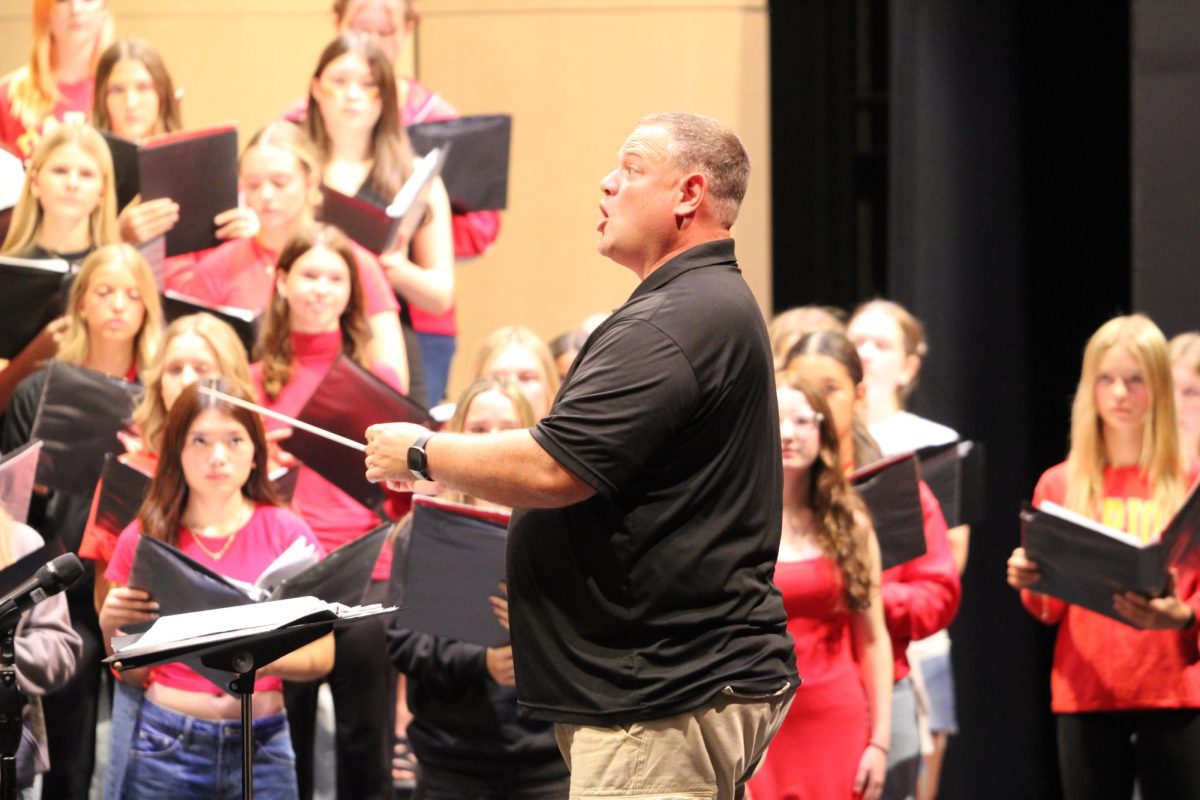
The chorus is an audition group of high school singers from across the state, with each high school bringing up to 28 students annually. Those who wish to attend begin preparing in August, when school starts, by taking voice lessons or attending various vocal camps. Jonathan Dyrland, choir director, has been taking students to auditions for 13 years, but has had the most success recently, with eight singers recalled and seven earning a spot in the group. This was an all-time record for him and was a huge accomplishment for the vocalists. He said, “I was very happy and excited for all of the students who made it, but also disappointed and a bit down for those who didn’t earn a spot. It’s that way every year for me, and it always will be, unless we bring 28 singers and they all make it in.” Dyrland credits this achievement to the way rehearsals were structured.
Previously, All-State auditioners were sent to practice in groups of four to work on what they felt needed the most improvement. However, this time, things were run a bit differently. Everyone was kept with the rest of the choir to rehearse and given more opportunities to meet with clinicians, who offered insight into what judges would be looking for. These professionals would come to practice during the school day with those planning to audition, such as teaching them proper technique and stylistic choices. Noel Burmeister, junior, has attended auditions three years in a row, and last month, he was accepted for the first time. He said, “Dyrland did do it a little bit differently this year. Instead of just sending us off to go practice by ourselves, he just kept us in class to learn, and it didn’t really work for me. But I guess for some other people it helped, and I think things were just run a lot better on Dyrland’s end.” Burmeister felt as though he didn’t get enough time during the school day to prepare all of the songs, but he put in the extra effort to go through them on his own as much as he could.
Some have started expressing their frustrations with the way All-State auditions are evaluated. When one goes to audition, their quartet will be directed to one of five rooms, each of which only has one judge present. This means that they only get a few minutes to perform and be scored by a single person, putting a considerable amount of power in their hands. Since music is so subjective, it makes it difficult to ensure the results are completely fair. Dyrland said, “I think a judge’s individual opinions about vocal tone and performance will differ from what is expected by a different judge, and this causes some good singers to get overlooked and some less-than-prepared singers to get selected.” He also feels that the extreme stress and worry experienced on audition day can cause some singers to go unnoticed.
Although the choir experienced great success, there are still improvements to be made for next year. Regardless of the audition results, the All-State process is an excellent way to develop one’s musical abilities and explore their creativity.