As the season of holiday giving commences, the demand for charities and donations rises. During this time of year, many businesses, clubs, churches, and other organizations aim their support towards local families who do not have the resources to fund presents for their children. On a higher level, some notable charities, including March of Dimes, the American Red Cross, and St Jude, help support people in need all around the world. Due to the vast majority of government funding cuts, the motivation to meet the needs of people both locally and nationally is bigger than ever before. Through all of the charitable work, many people overlook what is needed behind the scenes inside a non-profit organization, while also scrutinizing how every penny is used.
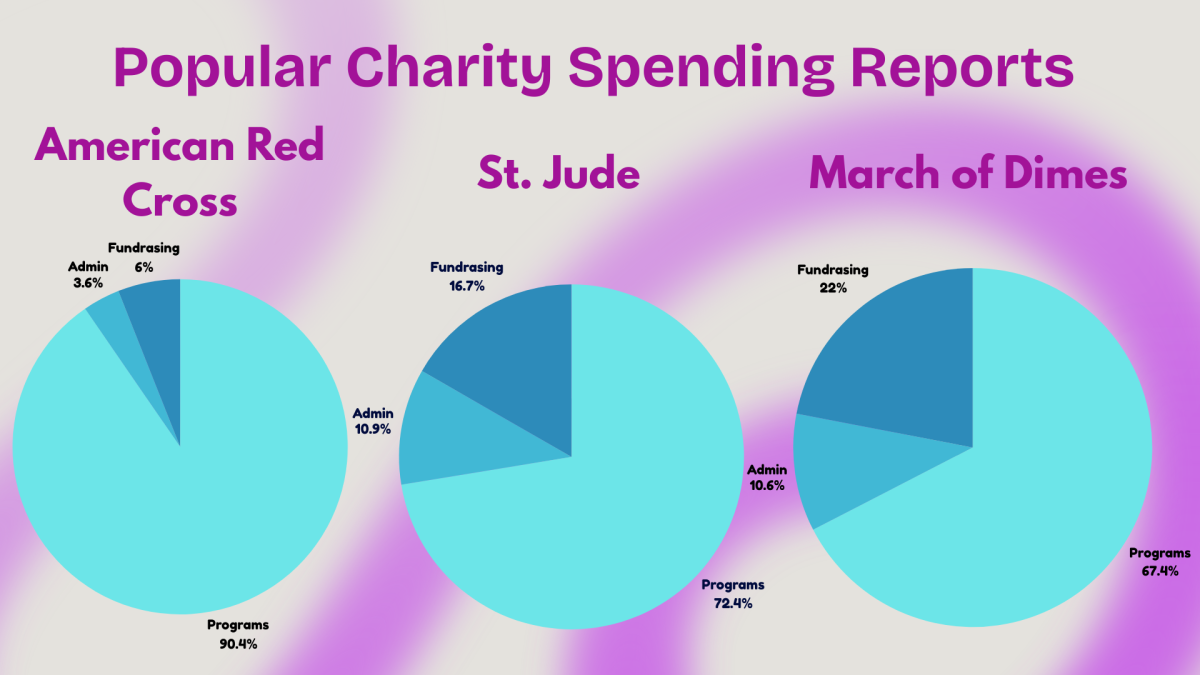
Anyone who has donated to a charity has most likely wondered where all their money ends up. An important question many donors want answered is how much of the funds are spent serving people in need. According to the Charities Review Council, at least 65% of funds should be spent on total annual expenses for programs, and no more than 35% on fundraising and administration combined. The famous entrepreneur and humanitarian activist, Dan Pallotta, when talking about charitable spending, said, “Everyone wants charities to spend as little as possible on overhead. That is backward. Overhead is what drives growth. If charities can’t grow, they can’t solve problems.” To explain, if the March of Dimes received a $1,000 donation, based on their budget breakdown, $106 would go to paying their administrative leaders, $674 would go towards supporting their mission, and $220 would be used to market, ultimately helping raise the number of additional donations. Instead of putting the entire donation towards their cause, March of Dimes needs to invest a portion of the money back into their organization.
The business rule of thumb, “you have to spend money to make money,” builds a strong double standard for non-profit organizations compared to for-profit businesses. The common assumption that non-profit workers should sacrifice fair wages for the sake of the cause is unrealistic. In reality, paying employees a fair, performance-based wage is necessary for a charity to truly thrive long-term. At their core, non-profits operate under a specific mission statement rather than a profit motivator. But like any company, they rely on administrators, marketers, educators, fundraisers, and countless others to keep it running like a well-oiled machine. Without skilled and reliable workers, the engine of a non-profit cannot run. Expecting their crucial staff to survive on no pay ultimately weakens the mission they are trying to support.
With the season of holiday giving beginning, it is essential to recognize the critical role that non-profit organizations play in addressing the needs of society. Despite the backlash of not pushing all their proceeds back towards their cause, investing portions by paying staff, building marketing campaigns, etc, is not a luxury; it’s a necessity for sustainable growth and effective service delivery. It is important for charities to prioritize transparency about where the proceeds are ending up, helping build trust with their donors. Despite the hurdles of searching for a reliable organization to support, the significance of helping others remains priceless.